Taxes in New Mexico: reform or the piecemeal approach?
With all of the talk about taxes and tax cuts this session, it is time for New Mexico’s elected leaders to get serious about some kind of comprehensive reforms. I explain RGF’s vision for tax reform in the Land of Enchantment over at NMPolitics.net.
In: Uncategorized
Exciting offer for high school students interested in the US Constitution!
The Rio Grande Foundation is pleased to announce that it is working with The Bill of Rights Institute to publicize this upcoming program.
The Bill of Rights Institute is pleased to offer 2 FULL scholarships (each a $1,500 value each) for New Mexico students to attend the Constitutional Academy this summer. This premier program for high school students to study the Constitution will be held in Washington, D.C. July 9-14, 2012.
The program explores the Founding principles of limited government, freedom of religion, and economic liberty to name a few. While in D.C. students will explore the Capitol, Mount Vernon, the National Archives, and other sites while in D.C. and have reading discussions with college professors. For more information please visit their website at www.billofrightsinstitute.org, or contact Michelle Griffes at (703) 894-1776, ext. 15.
In: Uncategorized
Of economic stimulus and austerity
With all of the economic turmoil going on in the world, the terms “austerity” and “stimulus” continue to be bandied about. It is time for some understanding of these words. Winthrop Quigley recently reported on comments by an analyst from Bank of the West who argued against the US adopting “European-style austerity measures” lest they harm our economy. OK, well, if “austerity” means massive tax hikes, I agree with him, but if it means spending cuts as happened in Canada, it seems hard to argue that such “austerity” is not needed. See the chart below on Canada’s massive spending reduction:

Besides, if “stimulus” means engaging in deficit spending to stimulate the economy, the US government has been “stimulating” the economy for decades now.
By way of illustrating the wasteful nature of government “stimulus” spending (which, after all is the “whole point”), I thought this cartoon was appropriate:
Egolf’s half-truths and obfuscations
Rep. Brian Egolf is among the furthest left legislators in New Mexico. He is a strong supporter of subsidies for the film industry and one of the most outspoken opponents of the oil and gas industry. He wrote an opinion piece that appeared in the Albuquerque Journal over the weekend which cited some polling data that attempted to paper over some very real issues and controversies over “conservation” and environmental policies.
One of the RGF’s most active supporters, Jim Crawford, did a thorough analysis of Egolf’s piece and the questions asked in the poll. Rather than duplicating his work, I have posted it in its entirety below:
Representative Brian Egolf’s column presented some questionable conclusions based on a poll (linked to here) by Colorado College.
Colorado College is a progressive liberal arts college which is enough to make the poll results questionable even before examining the poll itself.
Representative Egolf is correct. CONSERVATION is not a partisan divider. Conservation is the wise use and/or management of our resources. Conservation is a much different concept than the tree hugging anti-use EXTREME ENVIRONMENTALISM depicted in the illustration with the column.
Even the most conservative, pro-industry, cheap energy, drill baby drill advocates are conservationists. None among us favor wanton or wasteful destruction of resources. Hardly anyone opposes reasonable protections. The debate has never been about conservation versus jobs but about extreme environmentalism versus jobs.
As with most polls, the devil is in the details of how questions were asked. In the Colorado College poll, the questions were nearly all phrased in a way than nearly all of us would answer the same way. For example, who would not agree that “Our national parks, forests, monuments, and wildlife areas are an essential part of New Mexico’s quality of life” (Q20)?
Then there are the questions like Q2 where the choices are an option that nearly everyone would agree with or one that almost nobody would agree with. The choices were: “We can protect land and water and have a strong economy with good jobs at the same time, without having to choose one over the other. OR sometimes protections for land and water and a strong economy are in conflict and we must choose one over the other.” We presently have strong protection for land and water, a strong economy along with good jobs. It has never been about choosing one or the other. No wonder 80% of New Mexicans agreed with option 1.
Even more slanted are a series of questions where there are three categories of “serious problem” i.e. extremely serious, very serious, and somewhat serious. The only other choice is “not a problem”. Let’s face it. There is no human use or activity that has no impact. So again “not a problem” is not a likely option. However, if we view the somewhat serious category as one where there may be some minor within reasonable limits, then those percentages combined with the not a problem group exceeds the combined extremely and very serious group. A good example would be Q7 “The impact of oil and gas drilling on our land, air and water.” In NM only 31% put this statement in the extremely or very serious category while 65% put it in the somewhat serious and not a problem categories. New Mexicans are actually a lot less worried about these things than portrayed in Representative Egolf’s column.
Finally, Representative Egolf makes a big point about (QN2) where 71% of New Mexicans favored keeping our existing resource portfolio standards to force a certain percentage of renewable energy on our utility companies. Unfortunately, New Mexicans were never asked if they were willing to pay the $2.3 billion in increased electricity rates to achieve the standard. The answer may have been different in that case. There were no questions to test how much New Mexicans are willing to pay for utopian green quality of life statements.
We have all read the old adage about how figures lie and liars figure. This poll was designed to arrive at a predetermined answer and does not deserve a lot of credibility. The most surprising thing about it is that the results were not more skewed than they are.
Audio: recapping the 2012 legislative session
I was interviewed on “This week in Chaves County” on the good, the bad, and the ugly of the 2012 legislative session. Take a few minutes to listen by clicking on the first button here.
Goodbye (and good riddance) Ben Lujan
Heath Haussamen says it in a more polite manner here (and it is indeed a shame that it had to be cancer to drive Lujan from the Legislature), but House Speaker Ben Lujan embodies much of what is wrong with New Mexico politics. As discussed by Haussamen, Lujan is arguably responsible for killing the Gov.’s legislation to make sure 3rd graders who can’t read aren’t passed along through the school system to add to New Mexico’s 43% dropout rate. Lujan also prevented school choice tax credits from coming to the floor for a vote, thus protecting many of his fellow Democrats from having to vote against policy changes that is supported by 78% of New Mexicans and would provide a life line for New Mexico children who are in dire need of better educational options.
Will the heir-apparent, Ken Martinez be any better? I doubt it, but there is nothing set in stone saying he HAS to be the next house speaker.
Brief recap on 2012 legislative session
For the next few weeks, Gov. Martinez and her staff will be going through the bills that passed both houses this legislative session (find a list of those bills here). Here are a few “off the cuff” thoughts on the end of the session:
1) The failure to pass any significant education reforms is a travesty. The Gov.’s 3rd grade reading bills failed as did the tax credit scholarship bills. The especially galling fact about the scholarship bills (HB 166 and HB 65) both passed out of their respective House Committees, but Speaker Lujan refused to bring the Democrat-sponsored bills to the House floor for votes. Apparently, a majority in the Legislature is perfectly happy with 49th.
2) The tax cuts on the gross receipts tax that passed will help lower costs for some businesses. This is probably a good thing, but the piecemeal approach to tax reform is not ideal and will lead to increased tax complexity.
3) Some important reforms to the PRC passed and are great news. Kudos to our friends at Think New Mexico! The series of bills will increase the qualifications for PRC commissioners, transfer the PRC’s authority over the reporting and registration of corporations to a one-stop shop for business registrations and filings at the Secretary of State’s office; and remove the PRC’s authority over insurance and reforms how Superintendents of Insurance are selected.
4) No action was taken to resolve New Mexico’s massive $10 billion unfunded pension liability. This is a real problem. Failure to act now only makes the problem worse.
Government education vs. the free market
I often write about the need for free market forces in our education system. The problem is that in a heavily-socialized, unionized system like K-12 education, market forces are a foreign concept.
Given this reality, it is hard to understand how good education COULD be. But, as Mark Perry points out on Jay Greene’s blog, we have myriad products available in the marketplace that have grown better and cheaper over time. Don’t believe me? Check the post.
You’re invited to “Libre Initiative forum on economic freedom”
You are invited to the following free event:
THE LIBRE INITITATIVE PRESENTS: FORUM ON ECONOMIC FREEDOM
Thursday, March 1, 2012 at 8:00 AM-1:30pm (MT)
Hotel Albuquerque at Old Town
800 Rio Grande Boulevard Northwest
Albuquerque, NM 87104
The LIBRE Initiative along with its partners seek to inform the community about how Economic Freedom is critical to our community’s Economic prosperity. Confirmed panelists and speakers include:
Jon Barela, Secretary of Economic Development
Paul Gessing, President, Rio Grande Foundation
Dennis Kintigh, New Mexico State Representative, District 57
Carla Sonntag, Presdient, New Mexico Business Coalition
Gerges Scott, Vice President, Energy Unit, DW Turner
Read more and register for free here.
We hope you can make it!
In: Uncategorized
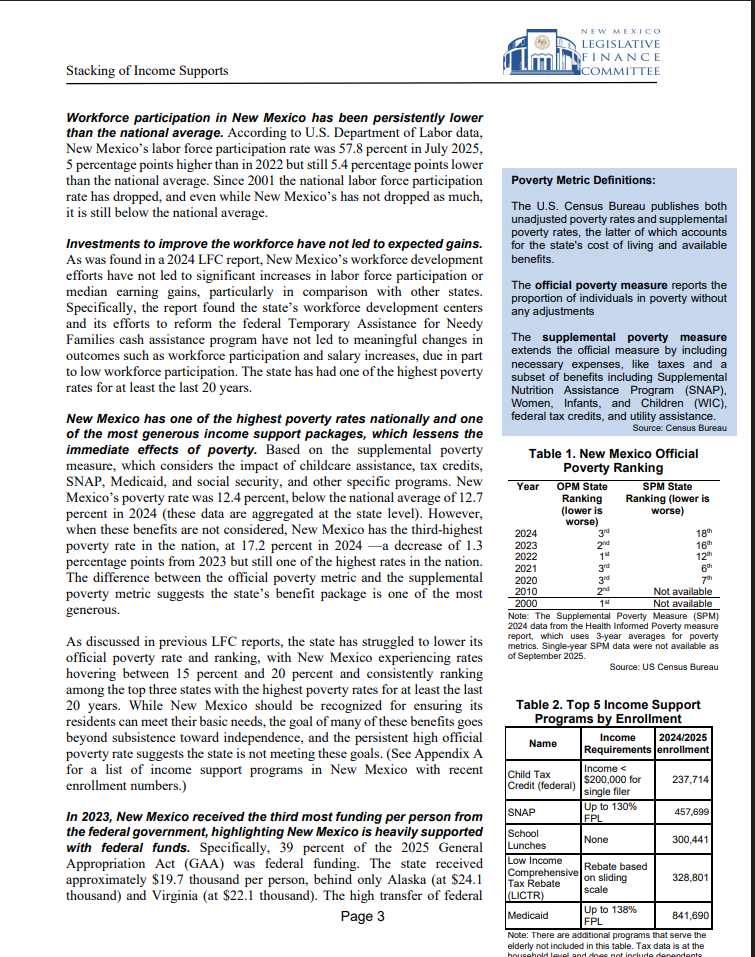
The geography of federal dependency
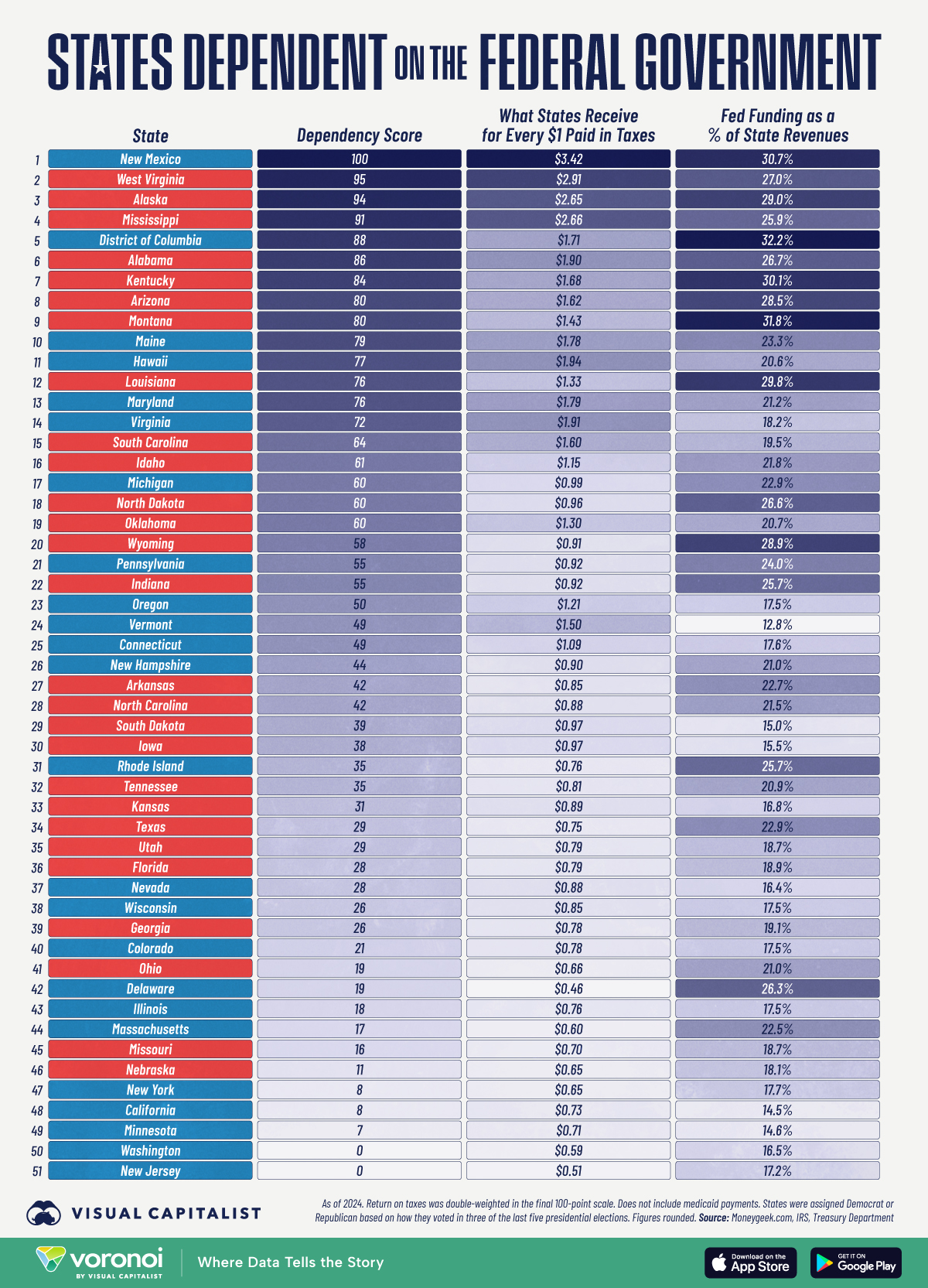
Want to know why America is in trouble? Take a look at this interactive website provided by the New York Times. It maps which counties throughout the US rely disproportionately on federal largess as a percentage of personal income.
Of course, New Mexico has more than its share of government-dependent counties, but we knew that already. The really scary thing is to click by the year (this map is from 2009) in the top right corner. Go back to 1969 and Americans are less than half as dependent on the federal government (7.8%) as they are today (17.6%).